You know the sound well. That low, comforting rumble when someone turns on the hot tap, followed by the subtle clicking of electronic ignition. The combi boiler sits in its stark white casing, usually hidden away behind a perfectly ordinary wooden door in your hallway or kitchen. It breathes out a steady, dry ambient warmth that faintly smells of hot copper and resting dust.
Most of us stare at the vast, empty cavern beneath the pipework and feel a mild sense of guilt. We have been conditioned to treat this space with suspicion, shaped by old tales of fire hazards from the 1970s and strict landlord warnings to leave the entire cupboard barren.
Yet, that terrifying void is nothing more than a mechanical misunderstanding. By treating the area beneath the casing as an untouchable wasteland, you are actively sacrificing the warmest, most naturally ventilated storage environment in your entire property. It is time to look at that dead air differently.
Rethinking the Danger Zone
The central myth surrounding the boiler cupboard is that it acts as a combustible trap of historical fear. In reality, modern condensing combi boilers are heavily insulated, highly regulated, and incredibly safe. Treating the space below them like an active volcano makes about as much sense as refusing to put plates in a warm oven drawer. The trick is not to ignore the manufacturer’s clearance guidelines, but rather to work precisely up to their edges.
Once you understand the mechanics, a surprising volume of usable air reveals itself. A standard wall-mounted boiler requires only around 200mm to 300mm of clearance underneath to allow a technician to access the valves and filter. Everything below that invisible boundary line is entirely yours to claim.
Consider Martin Davies, a 54-year-old Gas Safe engineer working across West Yorkshire. Martin spends his days opening these cupboards, and he is perpetually baffled by the sheer emptiness he finds. “Folks treat it like a shrine,” he chuckled during a routine service last November, tapping the cool underside of a standard unit. He pulled out a heavy-duty magnetic rack he kept in his van and clamped it straight onto the side casing of the boiler. He noted that for thirty quid’s worth of steel, you suddenly possess a drying rack that does not cost a single penny to run.
Tailoring the Warmth
Bringing this concept into your own home requires a little spatial awareness. Depending on your daily routines, that ambient heat can serve entirely different purposes, adapting to the specific demands of your household.
For the Winter Commuter, you can establish a dedicated drying zone for damp woollen hats, thick gloves, and scarves. Rather than draping them over living room radiators where they block heat and create condensation on your windows, hanging them in the naturally ventilated draught of the boiler cupboard dries them gently, completely avoiding the stale smell of trapped moisture.
For the Flat Dweller, if you are fighting for every square centimetre in a tiny bathroom, the dead space below the boiler is your new linen press. Stacking heavy cotton towels here keeps them bone-dry and beautifully warm for the morning shower, freeing up premium space under the sink.
For the Pet Owner, thick coats and muddy dog leads that usually clutter the hallway can sit on a low, slatted shelf at the very bottom of the cupboard. The gentle, descending warmth pulls moisture from the fabric slowly, creating an ambient warming drawer that stops wet gear from smelling musty.
The Magnetic Architecture
Transforming this space does not involve drilling into plasterboard blindly, terrified of hitting a concealed gas pipe. You must build a freestanding or magnetic system that respects the mechanics of the room. Minimalist, mindful actions are required here.
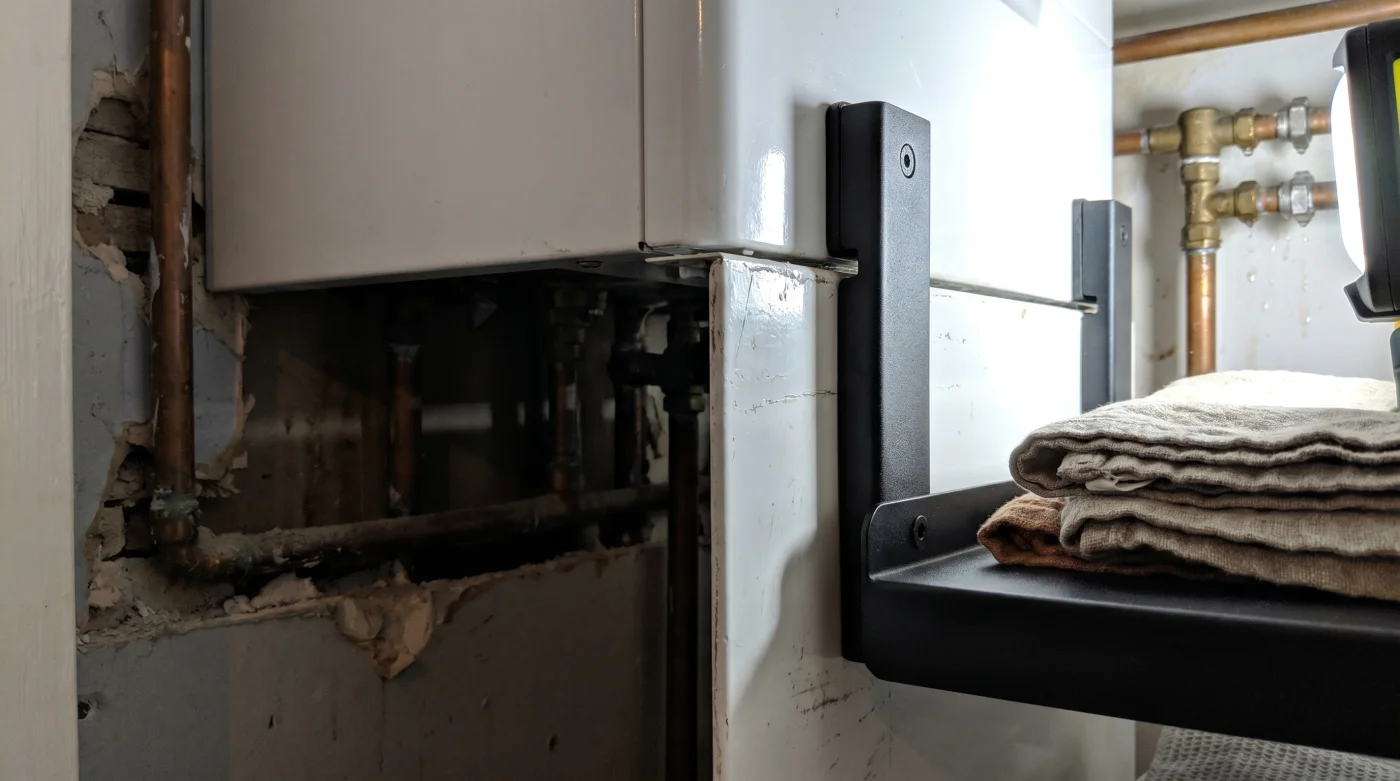
The simplest approach relies entirely on magnetic, heat-resistant shelving units. Heavy-duty neodymium magnets wrapped in silicone will stick firmly to the steel casing of the boiler without scratching the enamel or conducting dangerous levels of heat. The application is completely non-invasive.
To execute this properly, you need to follow a few precise steps to ensure absolute safety and maximum utility:
- Measure the clearance: Check your boiler manual. Find the minimum drop required below the pipes (usually 200mm) and mark this line with a piece of masking tape on the wall.
- Attach magnetic side-racks: Fix silicone-backed magnetic spice racks or utility shelves to the side panels of the boiler itself. These are perfect for small, lightweight items like damp socks or cleaning cloths.
- Install freestanding tension shelves: Below the masking tape line, use spring-loaded tension rods or a freestanding wire shelving unit. Avoid solid wooden shelves, as you want the warm air to circulate freely from the floor upwards.
Your tactical toolkit is brilliantly simple. You need a tape measure, a pair of silicone-coated magnetic racks, and a breathable wire rack. There are no drills or compromised pipes to worry about.
Claiming Back Your Square Footage
When you stop viewing your utility spaces as off-limits, the entire rhythm of your home begins to shift. It is deeply satisfying to slide a damp pair of gloves into a warm, hidden alcove, knowing they will be perfectly dry by morning without costing an extra penny in electricity.
It is about looking at your home through a lens of deliberate intention and quiet utility. By turning wasted air into a functional system, you are not just organising your clutter; you are claiming back the forgotten corners of your property. You finally make the house work for you.
“A home breathes better when every inch of ambient heat is given a job to do, rather than left to gather dust in the dark.”
| Key Point | Detail | Added Value for the Reader |
|---|---|---|
| Safety Clearances | Maintain a 200mm-300mm gap directly below the boiler pipes. | Ensures full compliance with Gas Safe regulations while freeing up the space below. |
| Magnetic Racking | Silicone-coated neodymium shelves attached to the side casing. | Provides instant, drill-free storage for lightweight damp items without risking damage. |
| Wire Shelving | Use slatted or wire freestanding shelves instead of solid wood. | Allows the ambient heat to circulate upwards, drying clothes faster and preventing mould. |
FAQ: Navigating Boiler Storage
Is it illegal to store things under a combi boiler?
No. As long as you maintain the manufacturer’s required clearance (usually 200mm-300mm below) for servicing and ventilation, the remaining space is perfectly legal to use.Will magnetic shelves damage the boiler casing?
Not if you use silicone-coated magnets. They grip the steel without scratching the enamel and do not conduct enough heat to cause any internal issues.Can I store paint or chemicals in the boiler cupboard?
Absolutely not. The ambient heat is perfect for linens and damp clothes, but combustible chemicals, aerosols, and paints should never be stored in a warm, enclosed space.Why do I need wire shelves instead of wooden ones?
Wire shelves allow the warm air to rise from the floor up through the linens. Solid wooden shelves block the airflow, which can trap heat and reduce the drying effect.What if my boiler cupboard has no ventilation?
If drying wet clothes, leave the cupboard door slightly ajar to let moisture escape, or swap the solid wooden door for a louvred door to encourage continuous natural airflow.