The morning air holds that familiar, biting dampness unique to a British November. You stand in the spare bedroom, feeling the distinct draught from the window frame, waiting for the cast-iron panel beneath the sill to push back against the chill. Downstairs, the boiler is humming its familiar, steady rhythm, pushing hot water through the floorboards.
Yet, your hand meets a surface that feels like cold stone. The system is running perfectly, except for this single, stubbornly frigid radiator. Your mind immediately rushes to the assumed protocol: calling a plumber, paying an £80 call-out fee, and suffering through a messy, hours-long system drain just to fix a tiny mechanical failure.
The thermostatic radiator valve, or TRV, sits quietly at the bottom corner, guarding the flow of water. We are taught to treat these white plastic dials as absolute boundaries. If turning it to ‘5’ does nothing, the assumption is that the plumbing itself has failed, requiring hoses, buckets, and lifted carpets.
But plumbing is rarely about catastrophic failure; it is usually about tiny mechanical protests ignored. What feels like a broken network is merely a seized component, resting too heavily against its housing after a long, inactive summer. You do not need to empty your entire central heating system to bring the heat back.
The Illusion of the Sealed System
Think of the TRV not as a complex electronic gate, but as a simple, mechanical throat. Inside that plastic housing sits a tiny metal pin. When the room warms up, a wax capsule expands, pushing the pin down to close the valve and stop the hot water. When the room cools, the pin rises, opening the throat to let the heat flow.
Over the summer, you likely turned the heating off, or turned the valves down. The pin stayed compressed for months. Metal bonded with metal, as microscopic calcium deposits settled into the joint. The flaw here—a pin that seizes in place—is actually a beautiful advantage. It means the water seal is completely intact. The water is safely trapped exactly where it should be. You are not fighting water pressure; you are simply coaxing a tiny piece of brass to let go.
Arthur Pendelton, a 64-year-old retired heating engineer from Halifax, spent forty years walking into freezing terraced houses where panicked homeowners had laid out old towels, expecting a flooded floor. He would kneel beside the offending radiator, ask the homeowner to step back, and perform a five-second action that felt almost like a magic trick. He rarely carried a drain hose into a home on his first visit. His secret was understanding that cold metal sometimes just needs a specific, waking shock.
Categorising Your Cold Radiator
Before applying pressure, you must understand how your specific environment dictates your approach. Not all seized valves require the same touch, and knowing your situation prevents unnecessary damage.
For the Cautious Renter
You likely feel anxious about altering any permanent fixtures. You fear losing your deposit over a snapped pipe. Your approach requires absolute minimalism. You will focus entirely on vertical, controlled pressure, ensuring the pipework below the valve takes zero lateral strain.
For the Confident DIYer
You might be tempted to grab a pair of grips and yank the pin upward. Resist this urge. Pulling a seized pin forcefully can break the internal seating, which actually would require a full system drain. Your goal is calculated vibration, not brute extraction.
For the Period Property Owner
Older valves, perhaps painted over during previous renovations, have a crust of gloss paint binding the collar. You must break this seal delicately using a craft knife to score around the plastic base before you even attempt to address the pin itself.
The Three-Millimetre Solution
Fixing this requires a very specific tactile response. You are aiming to send a shockwave down the pin to shatter the microscopic scale holding it in place. It is a matter of vibration, not force.
- The dead space under your combi boiler is actually a storage goldmine
- The 5-minute autumn guttering hack that prevents thousands in damp repairs
- Mechanics reveal the 2 pound mistake ruining your Bosch lawnmower over winter
- Plumbers are begging households to stop scrubbing copper pipes. Do this instead
Gather your tactical toolkit:
- A medium-weight adjustable spanner (the smooth flat side is crucial)
- A pair of flat-nose pliers
- A can of silicone spray
- A dry cotton cloth
First, unscrew the plastic TRV head. Most modern heads have a knurled metal or plastic ring at the base. Turn it counter-clockwise. It should unthread smoothly in your hand. Lift it away to reveal the central brass pin.
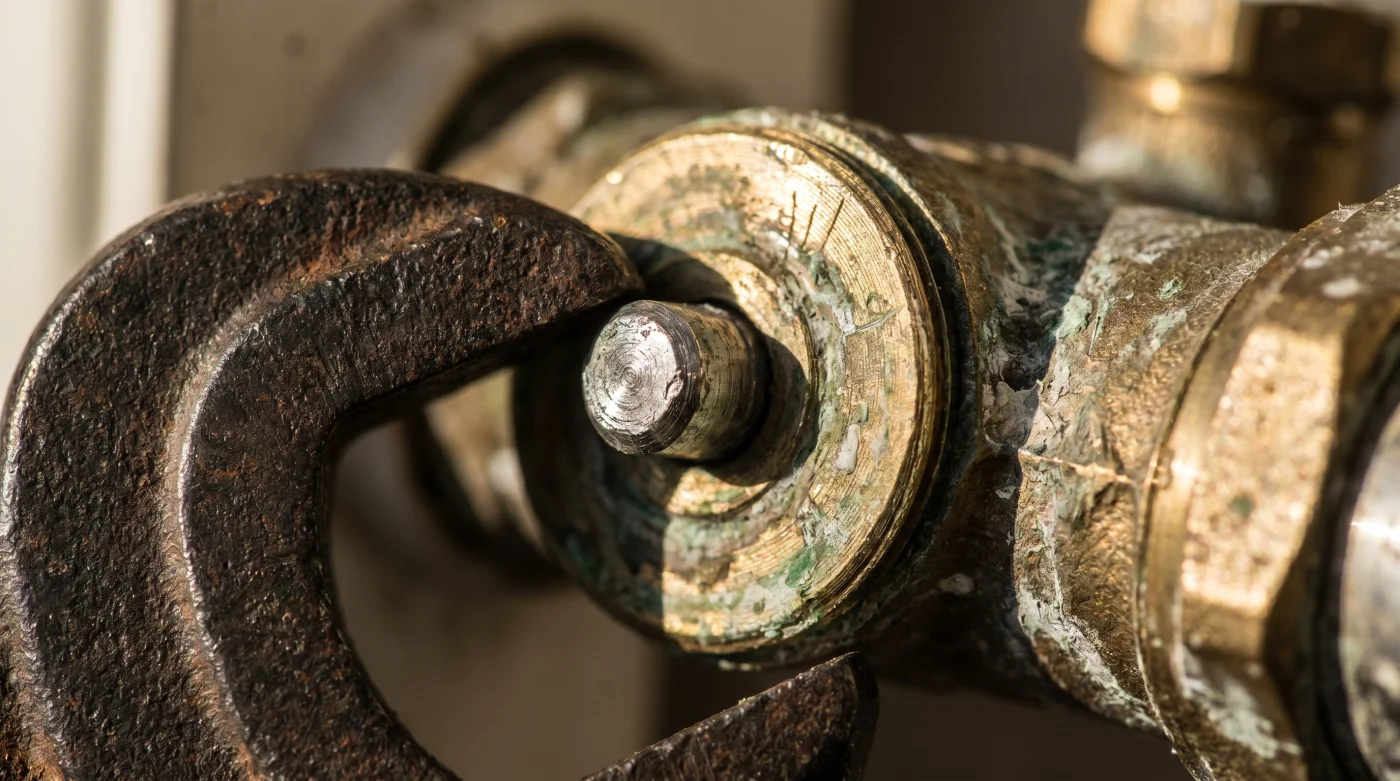
Press the flat side of your spanner against the top of the pin. Push down gently. If it lacks that spongy, spring-like resistance, it is locked completely solid.
Spray a tiny, single burst of silicone lubricant directly at the base of the pin where it meets the brass nut. Wrap your cloth around the base to catch any errant drips.
Here is the professional secret: Take the flat, heavy side of your adjustable spanner. You are not going to hit the top of the pin. Instead, you will tap the side of the valve body—the solid brass casing below the pin.
Apply a rapid, sharp tapping motion. Imagine cracking a boiled egg—firm enough to break the shell, gentle enough not to smash the yolk. You want the metallic clink to ring out.
After five or six sharp taps to the brass body, take your flat-nose pliers. Grip the pin gently and give it a microscopic wiggle from side to side. Do not pull it upward.
Tap the side of the valve body again. Suddenly, with a quiet metallic click, the pin will shoot upward by about three millimetres.
You will immediately hear the rush of water entering the radiator. The cold metal will begin to warm under your palm within seconds.
Reclaiming the Winter Hearth
There is a profound shift in how you view your home once you stop seeing it as a black box of untouchable systems. A house is a living, breathing mechanical entity. It settles, it seizes, and occasionally, it needs to be reminded how to move.
When you understand that a freezing room is not a catastrophic failure but merely a mechanical system holding its breath, you shed the anxiety of homeownership. You are no longer at the mercy of expensive call-out charges or the disruption of drained pipes.
That tiny metallic click—the sound of the pin releasing and the hot water rushing in—is the sound of true independence. You have mastered the boundary between the cold outside and the warmth of your quiet, comfortable space.
“A stuck valve is just cold metal holding its breath; a gentle mechanical shock tells it to exhale.” — Arthur Pendelton
| Key Point | Detail | Added Value for the Reader |
|---|---|---|
| Pulling the pin with pliers | Rips the internal rubber seal inside the brass casing. | Prevents a catastrophic leak and avoids forcing a £150 system drain. |
| Tapping the valve body | Sends a shockwave that shatters internal limescale. | Releases the pin safely in seconds using only basic hand tools. |
| Using silicone spray | Lubricates the metal collar without degrading the plastic housing. | Ensures the valve remains functional and responsive for the next winter. |
Frequently Asked Questions
Is it safe to tap the valve if my heating is turned on?
Yes, tapping the brass body is completely safe while the system is pressurised, as you are not loosening any water-bearing joints.
What if the pin goes down but won’t come back up?
The spring mechanism below is likely heavily calcified. Apply a drop of silicone spray, wait ten minutes, and repeat the tapping process on the side of the valve.
Can I use standard oil instead of silicone spray?
Avoid petroleum-based oils, as they can degrade the rubber O-rings inside the valve over time. Silicone is inert and safe for these components.
Why does my radiator only get warm at the bottom after fixing the pin?
Releasing the pin lets water in, but trapped air might still be blocking the top. You simply need to bleed the radiator using a standard key.
How often should I check my thermostatic valves?
Leave them turned to their highest setting during the summer months. This keeps the pin fully extended and prevents it from seizing in the closed position.